Thursday, April 15, 2010

In for the long haul: Pujato, Cordoba, and beyond

Buckle your seatbelts, gente. This will be a long and winding road..


So…remember that one time when I said I couldn't imagine life outside of Buenos Aires? Scratch that. I am now also completely capable of envisioning (and craving) life outside of the vida loca that is BA: specifically, life in the sleepy Midwest-meets-gaucho-meets-Mayberry town of Pujato and the classically Catholic city of Córdoba.


PUJATO


From the beginning: almost two weeks ago, on Sunday the 27th of March, I roused myself at an ungodly hour to meet my group and our very own minibus to journey into the interior of Argentina. We arrived in Pujato later that day [tangent: to get a sense of scale here – if you look at the map at the top of this page, Pujato is about half-way between Buenos Aires and Córdoba. The drive to Pujato took about four hours and it was more like 9 hours coming back from Córdoba to Buenos Aires – even though it doesn't look like much on the map. Conclusion: Argentina is HUGE. I forget about this sometimes.]

 Anywho, we arrived in Pujato and settled in with our host families for the week - this time with two students per family (in BA we all have our own). Rochelle and I lived with the Barulich family: Guillermo, Marcela (otra vez!), and their daughters Manuela (Manu, age 16) and Lara (13). Before I go any further in describing our activities, I just have to say that I AM SO IN LOVE WITH THAT ENTIRE FAMILY. They were so, so, so wonderful and completely opened their home and hearts to us. We really felt like part of the family after only a few days – they entertained us, asked us endless questions about life in the United States, showed us all around town, laughed at our Spanish mishaps and then gently corrected us, took us out with friends – it was all incredible. If I get the chance at all, I want to go back and visit them.

 El pueblo

 Pujato is a tiny town of about 2500-3000 people in the province of Sante Fe. The economy of the town is based almost entirely on agriculture and specifically on the production of soy. This has caused a host of social and economic changes in the region, not to mention some serious ecological/environmental damage, but I won't bore you all with those details. Well, only a little bit. One of the most important changes, arriving with the increased mechanization of agricultural practices and profits from the mono-crop cultivation of soy, has been the movement of people out of their homesteads in the fields and into the houses in town. Thus, my images of 'rural Argentina' were not to be found in Pujato: the town in very middle class, with all the amenities of 'modern' life (the Barulich family had more technological gadgets than either my Buenos Aires Marcela or my family at home…although with the latter that's not saying much). The culture is very distinct, however, with a huge emphasis on hospitality, family, and community ties. No one locks their houses during the day, everyone knows everyone (everyone knew who we were too, based on the fact that they didn't know us), people gather in groups in the central plaza on Sunday nights just to chat, everyone goes home at midday to eat lunch with their families, if you walk down the street you will get invitations to come into someone's house for a mate, etc. The overall atmosphere of the town was enchanting.

 Activities

 We did have a day of classes and some homework to keep us occupied, but that was all completely secondary to the experiences of living in Pujato and spending time with the family. At least that was my approach…

(hay que vivir, no?)


La feria


Our second day in Pujato, Marcela took the group to a cattle auction, or a feria de vacas, of which her father is the owner/proprietor. It was just the girls of the group, as the two guys were out working in the fields (ehehehe)…so it's not like we instantly stuck out at this heavily-testosteroned, Argentine cowboy event or anything. But it was so much fun – we got to ride horses, take pictures of cows (who doesn’t love that?), witness the auction itself (I kept repressing the Legally Blonde-like urge to exclaim "oh how cute, they have an announcer and cattle herders and everything!"), ask a lot of questions (I'm actually really interested in this kind of thing), and I can now officially testify to the fact that happy cows come from Argentina too.


 Coco,  Marcela's dad

Loading  the cows toward their final destination...

Happy cows, fresh from the field.

The auction arena. This gaucho-type character was in charge of herding/controlling the cattle during the  auction.

 El 'campo campo'

 Marcela got a big kick out of the fact that we had all thought we were going to be roughing it in the middle of nowhere. "No, no," she kept saying, "Pujato is the town, everyone lives in town, even the farmers. It's not 'campo campo' "(= really rural country, also can mean field). So she took us out to the campo campo, too. Her father's farm:


 cutecutecute. also that's Mario, Marcela's brother.

We rode out to the field in the back of the pick. That's the tractor used for harvesting the soy behind us...

...which we subsequently rode around on for the  afternoon. View looking down at the harvesting mechanism.


Bolsa de comercio

 The next day we went to Rosario, the biggest city of the province and one of other major cities in Argentina [tangent: BA is by far the biggest and most important city in Argentina, but after that it's Rosario and Córdoba. I'm still not sure which of these two is bigger, because in Rosario they claim that Rosario is the second biggest city in Argentina, but in Córdoba they assured me that the honor belongs to Córdoba. Regional rivalry, much?] Anyway, the bolsa de comercio is basically the commerce/stock exchange for grains coming out of Sante Fe and surrounding provinces, which is the majority of grains produced in Argentina. We toured inside the building, learned about the history and purpose of the bolsa, and then went to observe the room where all the brokers actually do the trading, but it was very unsatisfying because everyone had left (prices were low that day, apparently.) I was hoping for some good arm-waving/I'm-so-jazzed-about-this-capitalism-thing kind of action, especially because yelling is so much more expressive in Spanish. But sadly, no; instead we got to look at some very comfortable-looking leather chairs and snazzy computer screens.


After that, we walked around Rosario, to the famous Monumento a la Bandera and the river front.


View from the top

Facultad de Medicina Veteranaria

Next up in the arsenal of activities the families in Pujato had lined up for us: we went to the veterinary school located in Cacilda, a city-town about twenty minutes from Pujato. We chatted with one of the school officials for a bit [tangent: I was fascinated by the differences in breadth of focus – in Argentina they have a much more holistic approach to the connections between animal health/human health and so have options to specialize in public health, agricultural inspection, etc, all in veterinary school] and then we wandered around and looked at cute animals.


The vet school shares the grounds with the agricultural/animal husbandry schools as well. 

Freshly-born piggle wiggles! As in a few minutes old!


Dos caballos y una vaca???

 The next day, Marcela took the group out to her father's campo again to watch her brother practice paletada, the Argentine national sport. Now, a bit of back story: when we first arrived in Argentina, I heard about an Argentine sport that is very similar to polo (but more hardcore and dangerous) but couldn't remember what it was called and so I assumed that's what this was. Rochelle, on the other hand, had heard Marcela explaining the competition as involving dos caballos y una vaca (two horses and a cow) but was unsure what they did. Entertaining visions of a cow lumbering around a polo field, I thought this was pretty ridiculous and so we thought maybe she had misunderstood (there are frequent "did she say…? You're not sure either…?" – type conversations between us yanquis here in Argentina). It basically became a joke for us for the rest of the trip. But lo and behold, we arrived on the farm and it was exactly that – two horses and a cow. The two gauchos herd the cow between the horses and have to keep it between them for a certain distance to get points.


 Preparing...

Going...

Gone.

It was tons of fun, no matter what was lost in translation.


Fun random anecdote: one of the days, the Barulich family took us out to lunch at a parilla (grill) for asado (steak) [food tangent: OH. MY. GOD.] We were sitting there eating and the girls kept looking at this one guy sitting at the table next to us and they insisted that they recognized him from somewhere. Turns out it was a Latin American pop super star, named Axel (link to music video ehehe). We had never heard of him but this did not stop us from appreciating the fact that he is famous and dreamy. 

So Marcela, being a mom, went over to Axel and asked him to take a picture with us and the girls. Keep in mind that Rochelle and I were unshowered and basically in pajamas, due to another comprehension mishap that had led us to believe we were going to the club to work out. But Axel was very gracious and obliging (Rochelle fell instantly in love) and there now exists on Manu's phone a picture of two norteamericanas wearing UPS tshirts posing with Axel.


How to celebrate/commemorate such a wonderful week of hospitality and cultural exchange? Plant some trees, of course! Duh. So that's what we did on our last night: we gave trees to a local school and had a little planting ceremony with all the families and everything. So darn cute.

 I LOVE THIS FAMILY:


L to R: yours truly, Guillermo, Manu, Lara, Marcela, Rochelle (christened 'Ro' during our time with the Barulich's)


And then it was on to CORDOBA...

Friday morning of that week, the group split in two for Semana Santa travels (the long Easter weekend). The Córdoba crew departed from Rosario in the pouring rain. (Almost-not-so)fun fact about the Argentine bus system: they don't tell you which platform your bus leaves from specifically, only a range,  and the name on the side of the bus may or may not match the name on your ticket. How do I know this? We almost missed our bus because we were patrolling our designated range of platforms looking for a bus from our company, when it was actually there the whole time under a different company name. But, fortunately, Megann had the genius idea of asking the bus driver (how logical!) and so then we sprinted on just as it was about to leave. Disaster averted. Next (almost-not-so)fun fact: Semana Santa is prime vacation time for Argentineans…which  means that booking bus tickets/hostel spaces in advance is imperative otherwise it's extremely difficult to find any space. Now, this should not have been a problem, because we booked everything we needed in advance. However, we arrived in Córdoba that night after a seven bus ride and showed up at our hostel, where we were informed that they had no reservations for our group (of five) and, furthermore, that they had absolutely no space.

Shit.


After some moments of panic, we began calling hostels. Result: more panic, because nobody had space. Finally we found one that had four beds available, so we decided to show up at their doorstep and beg to let us share a bed, so that we wouldn't have to split into two groups. The gods/fairies/Che's-protective-spirit of Córdoba travel were looking out for us, because not only did they let us share a bed for the night, but they also had space for the rest of the weekend and it turned about to be an WONDERFUL hostel – amazingly helpful staff, rad people to hang out with – basically the perfect situation for us. Second disaster averted.


For the rest of that night, we went out to dinner [food tangent: redwine.redwine.redwine. it is sooooo delicious here] and then hung out at the hostel, basically staying up all night chatting and sharing music with a group of guys from BA also on vacation.


Saturday, Day 1: We broke down and did a tourist activity: a guided tour of Alta Gracia, a town outside of Córdoba ciudad capital, located in the hills surrounding the city. I LOVED leaving the city environment for a bit, especially because I have realized that I need a varied landscape (i.e. hills, mountains, water) to feel 100% comfortable in an environment (as opposed to the flat, flat, flat of the Sante Fe and greater BA). Also, Alta Gracia just happens to the town where Ernesto Che Guevarra grew up, the site of an old Jesuit mission, and the town where Manuel De Falla lived later in his life (and where he died) – destinations which destinations we visited with our tour.


mission visions:


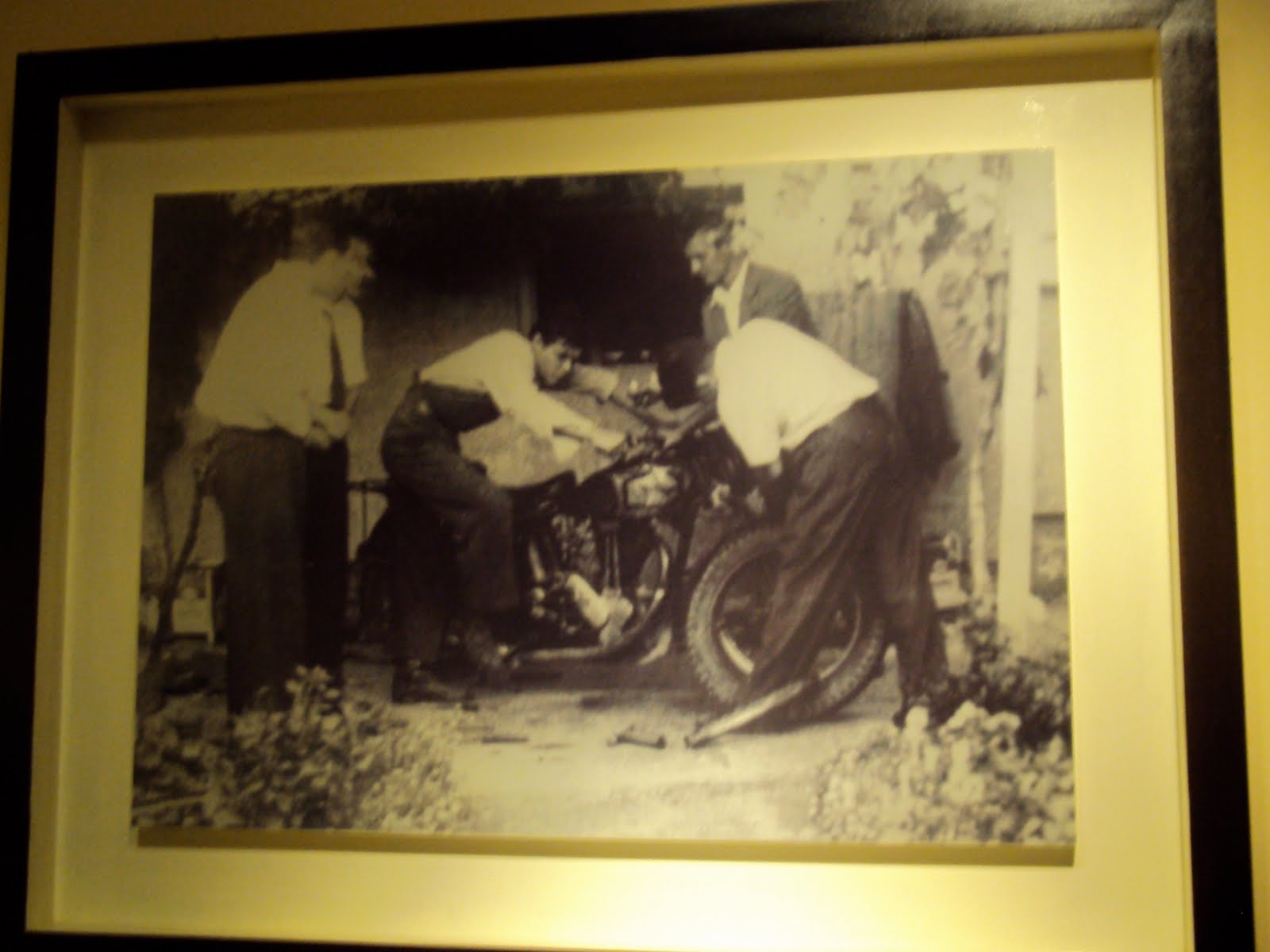
house of Che, where he lived from age 4 to 16ish:


La poderosa (a replica) - ultimate road trip vehicle of his Motorcycle Diaries fame


three-cornered house:


View from his house...not bad.


Composer caricatures game- can you guess (slash read) who's who??

Epic sunset on the bus ride back to the city.

We got back that night, napped, dined out, and attempted to find some hopping clubs. Kind of a fail, but we did find some quality ice-cream (which is far more satisfying in some respects). We had already decided we were going to stay up till at least 6, because Megann was returning to BA Sunday on a 6 a.m. bus (she didn't want to go home on the bus the rest of us would take – you'll see why) and we didn't want her waiting at the station alone. So we wandered a bit till then, got Megann on her bus, and went back to catch a few winks.


Sunday, Day 2: Sunday had a lazy start (for obvious reasons), but then we just wandered around the whole city [tangent: all cities seem small and highly walkable compared to BA, now), explored a cathedral or two, the parks, etc. It was quite delightful, and by the end of the day Córdoba had won me over.


 One of the highlights: dancing waters to the music of Queen. Oh yes it happened.


We were pacing ourselves with a late dinner, night activities, etc. because we knew we would be up till at least 3 a.m. again. Here's why: when we purchased our tickets to return to Buenos Aires from Córdoba the week before, there was already very limited selection. Our options came down to going home at 6 am on Sunday and therefore losing Sunday in Córdoba (which Megann decided to do) or taking an overnight bus that left Córdoba at 3:00 a.m. early Monday morning. You can guess which one the rest of us chose. Keep in mind that we had class at 1:30 that same Monday and the bus ride was an estimated 9 hours. But we decided to go for it, so we could get most possible out our time in Córdoba.


Lookin chipper at the Cordoba bus station at 3:00 a.m. Takes some skill, let me tell you.


We arrived back in Buenos Aires in one piece, albeit an hour late to class…toting luggage straight from the bus station…without having done the homework…


Whatevs, Ev. It was worth it. 

I'll try to get in another post on regular life updates since Pujato and Córdoba before I leave for Brazil and Paraguay on Sunday (!!!), but no promises. 

Besos a todos.

Saturday, April 10, 2010

¿Me han extrañado?

Hola compañeros,

My apologies for my long cyber absence. And also for the fact that it's going to continue. I don't actually have much time for an update, because  - believe me - once I sit down to do this thing it's going to be for the loooong haul. The last few weeks have had some fantastic visits, an amazing week in Pujato (in the rural interior of Argentina), a whirlwind weekend in Córdoba, boring boring classes with lots of homeworkuggggggghhhh, and some nerdy socially-conscious excitement as I narrow in on my topic for my independent research project. So...you'll just have to keep waiting, peeps. 

In the meantime, imagine me riding a tractor, visiting Che's childhood home, falling asleep in overnight buses and in class, procrastinating in my room by dancing around to Juanes and Jorge Drexler, or brewing my first mate (!!!).  And since I'm sure you've all had tons of free time since you haven't had to spend hours wading through my wordy escapades, here is a recommendation if you want a little taste of Argentina:

As I'm sure a lot of you know, Argentina won the Oscar for best foreign film for 'El secreto de sus ojos.' I've seen it twice now and it's a truly beautiful film, full of highly aesthetic cinematography, a sweet soundtrack, and a haunting story of the continuing legacy of Argentina's past. I loved it.

Here is the link to the film's website. I realize it's all in Spanish...but you can also Youtube the trailer with English subtitles.


Chau Chau


Wednesday, March 24, 2010

¡Viva la democracia!

Today was incredible. This is what I mean when I talk about the political engagement of Argentineans and how it makes my radical hippie heart happy:


Backing up: today (24 de marzo) marks the 34th anniversary of the military coup that began the seven years of military dictatorship in 1976. It is a national holiday, known as Día de la Memoria, so nobody has class or work and there are massive demonstrations all over the city.


We met up as a group, with one of our program directors as a protective mother hen (with what she refers to as her "Argentina clock" that senses when things might get dicy), in the Plaza Congreso, which is where Parliament and the legislative power is located. The historic path to march for political demonstrations is from the Plaza Congreso to the Plaza de Mayo, the political heart of the city and the center of executive power with the Casa Rosada.


So, we marched. Sadly, we weren’t allowed to march in the street with the political parties and demonstrators, but we followed the crowd from Plaza Congreso to the Plaza de Mayo. The march was divided into blocks of different political parties (there were something like 35 parties here - though, granted, a lot of them are off-shoots of Peronism) and other political or social organizations walking in groups, each with their flags, floats, pamphlets, and slogans. People were singing, chanting, drumming, giving speeches, etc.


When we arrived at the Plaza de Mayo, it was madness – impossible to move, there were so many people. There was a stage with some speeches and later live music (we had left by then). Interestingly (for me), the tradition is that the center of Plaza de Mayo is filled with the "oficialistas," or the supporters of the current neo-Peronist government, and later  in the afternoon, all the dissident opposition political parties march from Plaza Congreso and symbolically "take" Plaza de Mayo from the partidos del oficialismo (this was right about the time Valeria, our director, told us we should leave). Although there was some tension, the uniting political factor of the day was that of remembrance, with everyone rallying behind slogans like "La memoria y justicia" and "Nunca más."


I love seeing political passions in such a raw state. I'm thinking we should hit the streets.


Saturday, March 20, 2010

Que sé yo


Ok team, here is the plan: first I'm going to describe a bit about my routine here in BA, then I'm going to brag about all the cool stuff I've done, and then I'm going to wax eloquent on some cultural observations. If any of these topics seem brilliantly fascinating or incredibly boring to you, you have now been given advanced notice to skip around as you choose. This is going to take a while.

 Lo cotidiano

 I spend the majority of my week day in class or going to and from. Because I live in Belgrano and I have classes at IDES in Palermo, my daily commute is about 35-40 minutes each way on the subte. While I am not a fan of the hot and sweaty subte, I do enjoy the 10 minute walk from my house to the subte station everyday. Some photographic evidence:


Zapiola, the street where I live. My house is on the left, a little behind the first few trees.  

Trying to be artsy. Suggestions, Isabelle?

Lots of trees with big beautiful blossoms.


For me it has taken far more brain power to figure out what classes I'm having when and what I need to do to prepare for them than it has to master concepts of the material covered. This may come as a surprise to many of you, but I am not actually a very organized person (for those of you that have ever lived with me…I'm sorry). "Running around like a chicken with its head cut off" is a favorite expression of my grandma's and, I feel, an appropriate description of my general approach to life. So, as far as I can tell, we had scattered thematic classes last week, a whirlwind of a history seminar this week, and will move on to economics next week. The one constant is our Spanish class, which we have in the afternoons from 1:30-4:00 (or from 13:30-16hrs, I should say) at the Laboratorio de Lenguajes at the University of Buenos Aires.


 Las chicas bonitas in my Spanish class (missing Megan who joined later). Note the sheen of sweat. It's damn hot here. 

After classes, the routine varies. Sometimes we go to a café for a merienda (tangent: one of my favorite things about Argentines is how often they eat. Because lunch is generally 12-1ish and dinner is not until 9:30-10:00 pm, why not have a delightful snack of delicious strong coffee and some sweet mini croissants – called medialunas – at around 5?). Alternative options include wandering the city or being a good student and going straight home to read. Pfsht. (Tangent: we actually have a lot of homework. What the eff. So far I am struggling with the "study" part of "study abroad.)


 An excursion to Puerto Madero and the Puente de la Mujer (the bridge), built to resemble a woman dancing the tango.

Like I said, dinner is late here, which I actually really like because it prevents the notorious midnight snack phenomenon (maybe that's why Argentineans are smart and skinny, girls!). Marcela, being just generally awesome, is also a wonderful, wonderful cook and feeds me very well (erm…I think I am fated to remain fat and stupid).


The dining room/entrance/general living space of Marcela's house. To the left are the stairs that constitute the entry way (we live on the second floor of the house), Marcela's room is through that open door, and my room and the bathroom are to the right. The covered patio/living room and stairs to the terrace are behind me. 

 Weekends are a bit ridiculous. When you "go out for the night," the majority of activity actually occurs in the morning hours, as you are extremely early (ahem, American) if you show up to a bar or boliche (dance club) before midnight. Returning to one's house generally occurs around 6 or 7 am. I have definitely had some fun nights. Enough said.

 Lo incredible e interesante

 A brief overview of the more unique and interesting experiences I've had:

 Concierto para Chile

 Last Saturday there was a benefit rock concert for Chile, to demonstrate support for Chileans after the earthquake. It was in a huge park and there were thousands and thousands of people there (I read in las noticias the next day that there were something like 60,000). It had a very cool hippie-liberal-people-come-together vibe and even though I didn't know the words to a lot of the songs, the energy of the crowd was captivating. I just wish I was as cool as young Argentine people.


 Photo credit courtesy of the lovely Ms. Sadie Casamenti, as I forgot my camera. Of course. 

Desde la vida

 The host mom of one of the girls the program has her own television show on public tv, which centers on disability issues and contains interviews with medical experts, advocates, etc. It's called Desde la vida (From Life) and on Monday she invited us to come view the filming. We sat behind the cameras and watched the whole process, then got to wander around the station a bit to look at the shop, prop rooms, equipment, etc. (Note to Emily and Ella: I was about to take pictures of cool shop stuff for you – I finally remembered my camera! – and then the camera died. It was probably the most tragic thing that has happened in a long time.) The set of the show was decorated in mad colors and patterns, probably the handiwork of the small children. It was basically exactly how I would decorate my living room.

 St Patty's/Nick's 21st/La tempestad

 In the last few years, apparently, Argentina has begun to celebrate St. Patrick's Day in earnest (personally I think the Argentines are down with pretty much any excuse to party into the wee hours). So there was quite a big deal about St. Patty's here. Wednesday also happened to be the 21st birthday of one of the guys on my program, so OF COURSE we all had to go to an Irish pub. We really didn't have a choice. And, to make it all more blarney-tastic, that night there was the most amazing thunderstorm I have ever experienced. To say that it rained would be so big an understatement I don't know where to begin. There was thunder and lightening approximately every 20 seconds and ginormous gigantic torrential downpours. Being ever so slightly crazy, I maybe danced a little bit on the sidewalk while my vastly more mature (and East coast, non-rain-worshipping) group members looked on...

Museo Evita

 This past Thursday, the program took us to the Museo Evita, which – given such a subtle name, I know it's hard to figure out – is dedicated the life and memory of Eva Duarte Peron, wife of president Col. Juan Domingo Peron, also known as Evita. It's difficult to express the lasting power and significance of her legacy – she never actually held a political office but she is one of the most polemic figures in Argentina history, regarded by some as a secular saint (Santa Evita) and by others as a conniving whore (esa mujer, or "that woman"). While some of her methods were questionable, what cannot be denied is the strength of her commitment to the poor and the disenfranchised, especially to women and children.


Presidential couple.


 "I came from the people/they need to adore me/So Christian Dior me/From my head to my toes/I need to be dazzling/I want to be Rainbow High." Fun fact: Lyricist Tim Rice did not just pick the rainbow reference out of the clear blue sky (ahaha I so funny): Evita's European tour is actually known as the Rainbow Tour. 

Santa Evita 

Her funeral was a huge, huge deal, a big state affair that lasted for weeks. Even after her death she maintained such symbolic significance that ensuing governments after the fall of Perón actually stole her body and shipped it anonymously to Italy, to prevent people from rallying around her memory. Fortunately, it has been restored to the famous cemetery here in Recoleta.

Las Madres

Yesterday we had the opportunity to go as a program to the headquarters of the Madres de la Plaza de Mayo to meet a member. (Quick background for those that don't know: during the military dictatorship of 1976-1983 the government actively hunted "subversives" i.e. mostly young students, social workers, union members, political radicals, intellectuals, etc. and kidnapped, tortured, and often murdered them. These victims are known as los desaparecidos because they would just disappear from the lives of people who loved them and it was almost impossible to find out where they were held, if they were still alive, etc. It is estimated that there are about 30,000 desaparecidos and to this day it is unknown exactly what happened to the majority of these victims. Las Madres organized beginning in 1977 as a group of mothers of desaparecidos to protest the disappearance of their children and to demand information on their children's whereabouts. They still meet every Thursday at 3:30 to walk the Plaza de Mayo in protest and remembrance.)


Honestly, the actual conversation was a little underwhelming, simply because it was just one woman, and she had a bit of a standoff-ish personality. However, it was amazing to be in the building, see all the living history, and be one step closer to this incredible movement. One thing that she did talk about, which moved me a great deal, is the fact that Las Madres have moved beyond simply being a motherist movement demanding information about their missing children and instead have become an active participant in social justice work. Many of los desaparecidos were young, idealistic, and involved in community organizations to help the poor and so Las Madres decided to continue the work of their children, rather than simply mourn their losses. To do this, they have organized a free university, housing construction projects, and other such social work.  Prior to the formation of Las Madres, most of these women were typical Latin American housewives and mothers in a society marked by machismo, before the disappearance of their children motivated them to become politically involved.


To fight forever.


 The inside of la presidenta's office. The walls are covered with pictures of Las Madres with world leaders and different awards Las Madres have received. 


Memory and Peace

Observaciones culturales

 Here comes the part where I ramble about random subjects:

 One thing I love about Argentineans is how passionate and opinionated they are about everything. It doesn't really matter what the subject is – most Argentines have an argument ready and waiting (especially regarding politics: pretty much everyone here is very politically informed). I've noticed, however, that they often close their rants with "Pues, que sé yo" ('well, what do I know') - a habit I find myself adopting here. They are also very curious about what outsiders think: one of first questions I get whenever I meet a porteño is "So what do you think of los argentinos?" 


FOOD. As most of you know, I'm all about food. And the food here is delicious. Of course beef is the historic food of choice (mmmmmhmmmmm), but the cattle industry here is really struggling and prices are high; consequently, a lot of families can't afford to buy a lot of meat. There are lots of other delicious options: I've seem some super creative and delicious salads, really bready pizza, empanadas (!!!), sandwiches, etc. Another thing I like: there really is no "to-go" culture here. If you're eating, you're expected to sit somewhere and enjoy your food. Lunch breaks are longer, cafés and cafeterías are open super late, and food is a big element of the social scene. 

 I get pretty excited about meal times. 

Culture clash: It's been strange (and enlightening) to see my own U.S. culture, as well as others around the world, through the Buenos Aires lens. Ejemplos: there is a Barrio Chino (you guessed it: Chinatown) near my house. You have not heard Spanish until you've heard an attempted Spanish-as-a-second-language conversation between a blonde American and a Chinese immigrant in the beautiful city of Buenos Aires. Also, there are Burger Kings, Starbucks, and McDonalds all around the city. It kills my soul a little bit every time I see them…but apparently they're pretty cool here. Also, amusing anecdote: on one of my rides on the subte I was creeping on the woman sitting next to me (like you do) and so I was looking at the book she was reading. I began to see some familiar names appearing: "Eduardo," "Rosalia," and, of couse "ardiente" (=smoldering) and yep, Twilight ("Crepúsculo") has made it to Argentina. Let's all take a moment of silence to mourn.


Also, I just have to put this out there. ARGENTINEANS ARE BEAUTIFUL BEAUTIFUL BEAUTIFUL.  I'm not sure I've been clear enough here. Let me try again. ARGENTINEANS ARE UNBELIEVABLE GORGEOUS. Really, peeps, no matter what your preference is, there are plenty of pretty people to gawk at down here. I suggest you all hop on a plane immediately. Somehow they have all mastered the uber-cool tousled skinny sexy look, which most of the time just leaves me feeling awkward and a bit like an elephant. So, you know, the usual.

Hokay, I think I've probably bored you all to death enough for today. Sending you all un beso, Argentine-style. 


Tuesday, March 16, 2010

Somos el tiempo

Please indulge my literary wanderings. 
I'm reading Argentine poets instead of doing my homework. 

We are the time. We are the famous
metaphor from Heraclitus the Obscure.

We are the water, not the hard diamond,
the one that is lost, not the one that stands still.

 We are the river and we are that greek
that looks himself into the river. His reflection
changes into the waters of the changing mirror,
into the crystal that changes like the fire.

We are the vain predetermined river,
in his travel to his sea.

 The shadows have surrounded him.
Everything said goodbye to us, everything goes away.

 Memory does not stamp his own coin.

 However, there is something that stays
however, there is something that bemoans. 

- Jorge Luis Borges

Sunday, March 14, 2010

Momentos y sentimientos

Right now it's hard to imagine life outside  Buenos Aires. I have fallen in love so completely with this city it's ridiculous. Of course there are things I'm not so thrilled about (por ejemplo how hot and crowded the subte is, the lack of clean air for my poor little country lungs, not to mention the large amount of visible poverty), but at least for now these don't compare with vibrance of life here. There is a fantastic spirit of vitality and history and alternative perspectives that has me completely captivated.

Classes started last week, but the jury is still out. Right now a lot of it is review of concepts I'm already familiar with or just plain busy work...but that could be the resentment-of-this-incursion-of-my-free-time talking. I still haven't come down from the feeling of limitless exploration of the city. Homework? What? Excuse me while I spend the afternoon in a park with thousands of porteños at the benefit concert for Chile. Weekends that start on Wednesday or Thursday night don't really help either.

I don't have any new pictures for this post because I am a complete and utter failure at remembering to bring my camera with me. But I solemnly swear to be better about this next week. And that I am up to no good. 

Besos.


Sunday, March 7, 2010

Estoy acá

Bueno. I'm officially here in Buenos Aires, Argentina (!). There is so much to say and explain, so I think my only option is to cyber-vomit a brief summary of everything. And by 'brief' I mean it will probably be very long.

 Flights, etc.

Being the die-hard frugalista that I am, my flight was pretty much the cheapest possible. And there was a reason why is was so inexpensive, in addition to the genius of Student Universe. Basically, I leap-frogged (leapt-frogged? Frog-leapt?) my way down the Latin American continents, with several short flights and a total of three connection lay-overs ranging from 30 minutes to six hours. Thus, it turned out that I was traveling for over 24 hours, with less than 7 hours of sleep spread out over 2-3 days. 'Twas grand. But I did get to spend some quality time in the airports of Latin America.


Case in point: my view from the Costa Rican airport from the spot where I hung out for about six hours.

Orientation, etc.            

I was a little bedraggled upon arrival, especially because I got sick right before leaving. So my lovely group members and directors did not hear my real voice for about three days, as I croaked out my often-incoherent mixture of English, Spanish, and nonsense.

 The SIT directors, without a doubt based on their past experiences of welcoming bewildered Americans into their country, immediately whisked us away to a beautiful estancia about 50 minutes outside of the city. It was lovely and tranquil and sososo gorgeous, and a wonderful spot to begin orientating activities.

I offer proof:


 The two guest houses. I was in the smaller one to the right. 


The beautiful grounds. Yup, there was a pool.


 The living room of our guest house. It had the feel of an old-style estancia, with lots of horse/gaucho decor (it also has a stable and is a popular destination for vacationing polo players)

After a relaxing day and a half at La Estancia Don Manuel, we ventured into the city to continue our orientation. Most of these activities took place in or around the Instituto del Desarollo Económico y Social (Institute for Social and Economic Development), known as IDES. Such activities included, in no particular order: tips on how to deal with the, ahem, persistence of Argentinean males (Come find me, Gilberto!), tips on how not to contract and die from AIDS, opportunities for sharing stories and pictures and warm-fuzzy group bonding, watching cute British boys play polo [tangent: apparently polo, as in on horses, is second only to fútbol in national popularity], tips on how not to contract and die from a mosquito-born illness [tangent: initially I scoffed at the idea of bug spray because I don't scare that easily. I have now embraced it as my favorite thing in life, after empanadas. Word of advice for Evie: er…you probably should never come here.], tips on how not to be assaulted and killed by a mugger, excursions for helado (ice cream), a placement test in español that destroyed whatever remnants of self-esteem were left from trying to talk to los porteños (Buenos Aires locals), an evening of attempted bonding with some students of Universidad de Buenos Aires, tips for how not to appear like an obnoxious American (essentially, don't be loud or arrogant or sleep with everything that moves), EMPANADAS, a "drop-off" activity that involved setting us loose on the city in pairs with a map and an assigned destination [tangent/amusing anecdote: I was a bit nervous for the drop-off, as my partner (Rochelle, the other UPSer) and I both admitted to a laughable sense of direction. However, we asked for directions, navigated the subte (subway) with flair, hid in corners to look at the map so we wouldn't look like tourists, found our destination, found the confidence to explore more, and felt entirely successful until we realized that neither of us remembered the exact street and address of IDES, where we were supposed to return. Fortunately, I remember things connected to food quite well, and we were able to recognize an ice cream place we'd visited and find our way from there. Disaster averted.], tips for the best bars and shopping, and FINALLY meeting our host families.

 Pictures of the city:


This was a randomly gorgeous building that, after we asked a random stranger on the street [tangent: Los porteños are endlessly gracious and helpful as we try to navigate their city], we found out used to be a city water administration building and is now full of private offices.


An important Jewish temple and museum. Also note the park. There are lots and lots and lots of parks and beautiful big trees lining all the avenues - enough to prevent this avid North-westerner from going crazy from lack of green.


The obelisk marks pretty much the absolute center of the city. Also, fun fact: this is the Avenida 9 de Julio, which is the widest avenue in the world.


And of course: La Plaza de Mayo and the Casa Rosada. The Plaza is the site of every major protest and social movement in the country and has huge symbolic importance (think Madres de la Plaza). Also, the Casa Rosada was the presidential residence and the site of Evita's famous speech.


Proof that I'm actually here and not constructing some bizarre cyber fantasy.

Host family, etc.

Friday night we moved in with our host families. I live with a single lady (nobody put a ring on it) named Marcela, who is in her mid-40s. So far, I love her. She is completely groovy – exactly the type of woman I'd want to be if I were a single Argentinean psychologist. From the moment I saw her decked out in tye-dye pants and big colorful beads, I knew we'd get along. She's a hippie after my own heart: a pacifist who sings, has theater and musician friends, is a member of Green Peace, and cries when she talks about homeless children and trying to create a better world. She is endlessly patient with my language skills (we speak only Spanish together) and also has two adorable dogs who I have already fallen in love with. I also have my own room, which is lovely. The house is in Belgrano, which is a 15-20 ride on the subte from IDES and the Palermo district.


The lovely Lola. She is completely precious. I'm learning how to sweet talk in Spanish.


Uma, after Uma Thurman. Note the resemblance. Also akin to a mop. Absolutely darling.


My room. The bed is divinely comfortable. The window connects to a covered patio where we open all the windows at night so I don't suffocate.


Most important item in this picture: the fan. I knew it was going to be the end of summer when I got here, but I never imagined it would be this hot. I'm going to wear my one tank top down to threads. 


 The best part of the house: this beautiful roof top terrace. You can see the city, but be a bit removed from it at the same time. Mornings and evenings are obscenely pleasant on the terrace - Marcela and I eat breakfast and dinner there right now. 

El languaje, etc.

 Well. The Spanish aspect of things has been interesting: I feel that I have moments of brilliance where phrases flow out of my mouth in an astonishingly natural way…and then there are times when the simplest words leave me stuttering and surrounded by blank stares. Also, although I love the Argentine accent (it is VERY distinct), I also find it more difficult to understand than most because they speak at approximately the speed of light, use 'vos' instead of 'tu' - which has different conjugations - and pronounce the 'll', 'y,' and other consonant sounds very harshly – sometimes almost unrecognizably so. What I am certain of, however, is that it will be impossible for me not to improve. I have listened to and spoken more Spanish in the last three days since arriving to the city than I would in an entire semester at UPS. I'm glad that my SIT group seems equally dedicated, as we have agreed to speak only Spanish amongst ourselves unless we are in a private place and absolutely need to revert to English. And as I mentioned earlier, it is Spanish only in our homestays. It is comforting to know that this will be my low point, language-wise.


That's it for now, peeps. Classes start Monday and then I'll have a whole new set of adventures.